📌 Introduction
Laptop technology is evolving faster than ever. In the past, improvements focused mainly on processing speed and storage capacity. Today, the focus is shifting toward artificial intelligence (AI), energy efficiency, advanced displays, and new processor architectures.
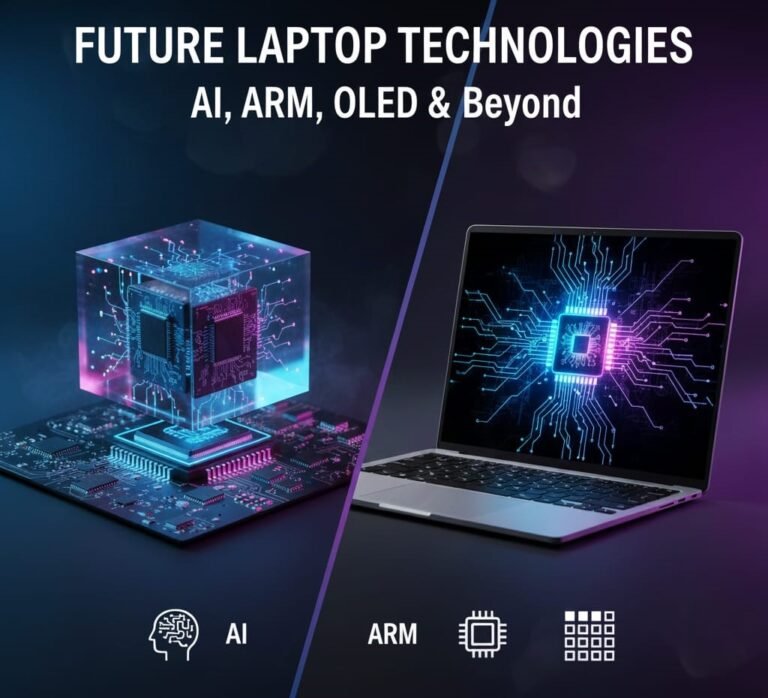
Future laptop technologies are evolving faster than ever. Modern laptops are no longer just about speed and storage — they are now integrating artificial intelligence (AI), energy-efficient processors, and advanced display technologies. These future laptop technologies are shaping smarter, faster, and more powerful devices for work, gaming, and creativity.
In this guide, we explore the future laptop technologies that will shape the next generation of devices, including:
✔ AI-powered laptops
✔ ARM-based processors
✔ OLED and Mini-LED displays
✔ Foldable and dual-screen designs
✔ Battery and cooling innovations
✔ Next-generation connectivity
Let’s explore what the future holds for laptops. 🚀
🧠 Future Laptop Technologies: AI and Intelligent Computing
Artificial intelligence is one of the most important future laptop technologies. AI is changing how laptops operate, making them more responsive, efficient, and personalized.
AI-Powered Processors (NPUs)
Modern laptops now include Neural Processing Units (NPUs) alongside CPUs and GPUs.
NPUs are designed specifically for AI workloads, allowing laptops to process intelligent tasks locally without relying entirely on cloud servers.
Benefits of NPUs
• Faster AI processing
• Reduced power consumption
• Improved multitasking performance
• Enhanced privacy through local processing
Examples of AI features in laptops include:
• AI noise cancellation during calls
• Smart image and video enhancement
• Real-time voice recognition
• Intelligent performance optimization
As AI hardware becomes more powerful, laptops will increasingly function as smart digital assistants rather than simple computing devices.
AI Performance Optimization
Future laptops will automatically adjust performance based on how users work.
Artificial intelligence will help systems:
• Adjust CPU and GPU power dynamically
• Optimize battery usage
• Manage background applications
• Predict user workloads
This means laptops will deliver better speed and longer battery life without manual adjustments.
AI for Productivity and Creativity
AI is also transforming professional workflows.
Future laptops will support tools such as:
• AI coding assistants for developers
• Automated video editing
• Real-time transcription and translation
• Intelligent document summarization
These features will make laptops more productive for professionals, students, and creators.
⚙️ Future Laptop Technologies: ARM-Based Laptops
Another major shift in future laptop technologies is the transition from traditional processors to ARM-based architectures.
ARM Processors and Efficiency
Traditional laptop processors often consume more power and generate more heat. ARM processors focus on efficiency and performance balance.
Advantages of ARM Processors
• Extremely energy-efficient
• Longer battery life
• Cooler operation
• Instant wake and always-on connectivity
Some ARM laptops already deliver 15 to 25 hours of battery life, which is a significant improvement compared to older systems.
Apple Silicon and Its Industry Impact
The success of Apple Silicon proved that ARM processors could deliver desktop-class performance with exceptional efficiency.
Key advantages include:
• High performance per watt
• Silent operation
• Unified memory architecture
• Strong AI acceleration
Because of this success, many manufacturers are now investing in ARM-based laptops.
Windows on ARM
Support for ARM processors in Microsoft Windows has improved significantly.
New developments include:
• Better application compatibility
• Native ARM software support
• Improved emulation performance
• Integrated AI acceleration
This progress suggests that ARM laptops may become mainstream in the near future.
🖥️ Display Technology Evolution
Displays are another area where future laptops are rapidly improving.
OLED Displays
OLED displays are becoming more common in modern laptops.
Benefits include:
• Perfect black levels
• Infinite contrast ratios
• Vibrant colors
• Faster response times
OLED laptops are particularly beneficial for:
• Media consumption
• Creative professionals
• Gamers
In the coming years, OLED displays may become standard in many laptops.
Mini-LED Displays
Mini-LED technology improves traditional LCD displays by using smaller backlights.
Advantages include:
• Higher brightness levels
• Improved HDR performance
• Reduced risk of burn-in
• Better energy efficiency
Mini-LED displays are especially useful for designers, video editors, and professional users.
Foldable and Dual-Screen Laptops
Laptop designs are also evolving beyond the traditional clamshell format.
New form factors include:
• Foldable display laptops
• Dual-screen productivity devices
• Expandable displays
These designs offer:
• More screen space
• Improved multitasking
• Greater portability
In the future, some laptops may replace external monitors entirely.
🔋 Battery and Charging Innovations
Battery technology is improving rapidly and will play a key role in future laptop technologies.
Next-Generation Batteries
New battery technologies aim to provide:
• Higher energy density
• Faster charging speeds
• Longer lifespan
• Improved safety
Future laptops may deliver multi-day battery life for light workloads.
Faster Charging
Charging technology is also improving.
Future laptops may support:
• 50% charge in just a few minutes
• Universal USB-C charging
• Intelligent power management
Charging a laptop could soon become as quick and convenient as charging a smartphone.
❄️ Cooling and Performance Design
Efficient processors and improved cooling solutions are enabling new laptop designs.
Silent Cooling Systems
Modern cooling innovations include:
• Vapor chamber cooling
• Advanced thermal materials
• Passive cooling systems
These technologies allow laptops to operate:
• Quietly
• Efficiently
• With reduced heat generation
Many future laptops may operate without traditional fans.
Advanced Materials
Manufacturers are also exploring stronger and lighter materials such as:
• Magnesium alloys
• Carbon fiber
• Ceramic coatings
These materials allow laptops to be:
• Thinner
• Lighter
• More durable
🌐 Future Connectivity
Connectivity technologies will also improve in upcoming laptops.
Wi-Fi 7
Future laptops will support faster wireless standards like Wi-Fi 7, offering:
• Ultra-low latency
• Faster wireless speeds
• More stable connections
This is ideal for cloud gaming, remote work, and streaming.
Always-Connected Laptops
Built-in cellular connectivity is also becoming more common.
Future laptops may support 5G and eventually 6G connectivity, enabling internet access anywhere without relying on Wi-Fi networks.
🔐 Security and Privacy Innovations
Security features are also evolving with new technologies.
Future laptops may include:
• AI-driven threat detection
• Behavioral authentication
• Real-time security monitoring
Biometric systems such as face recognition and fingerprint sensors will also become more advanced and secure.
🧭 Should You Buy Now or Wait?
Buy Now If
• You need a laptop immediately
• Current hardware meets your needs
• You are not waiting for emerging technologies
Wait If
• You want AI-optimized laptops
• You prefer ARM-based devices
• Battery life is your top priority
🏁 Final Verdict
The future of laptops is focused on intelligence, efficiency, and improved user experience. Technologies such as AI processors, ARM chips, advanced displays, and new battery innovations will transform how laptops are used.
Future laptop technologies will prioritize:
✔ Intelligent computing
✔ Energy efficiency
✔ Innovative display designs
✔ Longer battery life
✔ Smarter software experiences
The next generation of laptops will not only be faster — they will also be more adaptive, efficient, and personalized than ever before.
About the Author